Deploying RHEL with ECI DNF Repository¶

Prepare Target System with RHEL¶
The section is applicable to:

To leverage all ECI features, the target system should meet the recommended system requirements. Also, the target system must have a compatible OS so that you can install ECI Deb packages. This section explains the procedure to install a compatible OS on the target system.
Please note, some feature compatibility (ex: integrated graphics) is dependent on the OS distribution installed on your Intel platform.
Use the table below to determine which ECI supported OS distribution(s) you should use with your Intel® platform to achieve best results:
Distribution |
Distribution Version |
< Intel® platforms > |
||||||||
|---|---|---|---|---|---|---|---|---|---|---|
|
Series 3 Core™ Ultra (PTL) Panther Lake |
Series 1/2 Core™ Ultra (MTL/ARL) Meteor / Arrow Lake |
7000 Series Intel Atom® (ASL) Amston Lake |
14th/13th Gen Core™ (RPL) Raptor Lake |
12th/11th/9th/8th Gen Core™ (ADL/TGL/CFL/WHL) Alder / Tiger / Coffee / Whiskey Lake |
Xeon® D-1700 (ICL-D) Ice Lake D |
6000E Series Intel Atom®™ (EHL) Elkhart Lake |
|||
< Debian > |
Debian 12 (Bookworm) . |
✔ |
✔ |
✔ |
✔ |
✔ |
✔ |
|||
Debian 11 (Bullseye) . |
✔ |
✔ |
✔ |
|||||||
< Canonical® Ubuntu® > |
Canonical® Ubuntu® 24.04 (Noble Numbat) . |
✔ ‡ |
✔ ‡ |
✔ |
✔ |
✔ |
✔ |
✔ |
✔ |
|
Canonical® Ubuntu® 22.04 (Jammy Jellyfish) . |
✔ |
✔ |
✔ |
✔ |
✔ |
|||||
< Red Hat® Enterprise Linux® > |
Red Hat® Enterprise Linux® 9.3 (Plow) . |
✔ |
✔ |
✔ |
✔ |
✔ |
||||
Key |
Symbol |
|---|---|
‡ |
Do the following to prepare the target system:
To achieve real-time determinism and utilize the available Intel® silicon features, you need to configure certain BIOS settings. Reboot the target system and access the BIOS (press the delete or F2 keys while booting to open the BIOS menu).
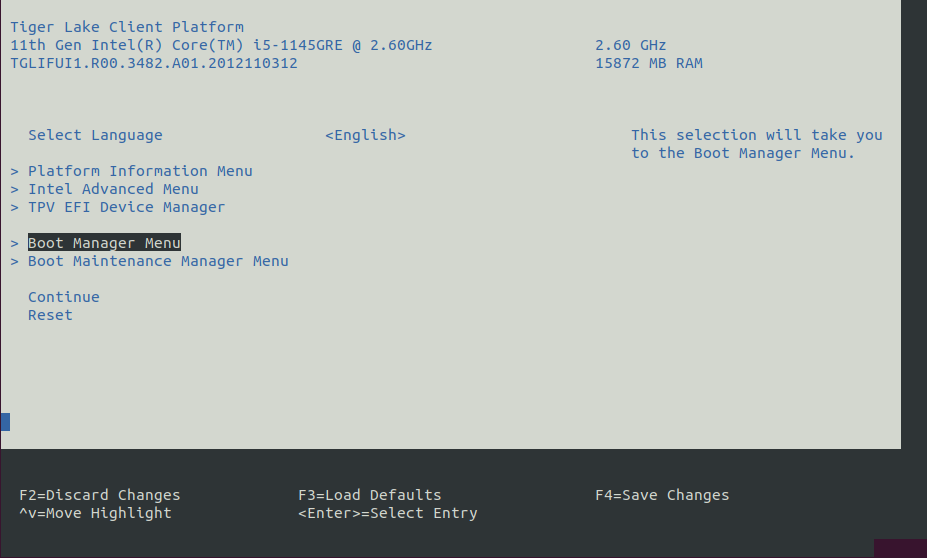
Select Restore Defaults or Load Defaults, and then select Save Changes and Reset. As the target system boots, access the BIOS again.
Modify the BIOS configuration as listed in the following table.
Note: The available configurations depend on the platform, BIOS in use, or both. Modify as many configurations as possible.
Setting Name
Option
Setting Menu
Hyper-Threading
Disabled
Intel Advanced Menu ⟶ CPU Configuration
Intel Virtualization Technology (VT-x)
Disabled* (see footnote)
Intel Advanced Menu ⟶ CPU Configuration
Intel(R) SpeedStep
Disabled
Intel Advanced Menu ⟶ Power & Performance ⟶ CPU - Power Management Control
Turbo Mode
Disabled
Intel Advanced Menu ⟶ Power & Performance ⟶ CPU - Power Management Control
C States
Disabled
Intel Advanced Menu ⟶ Power & Performance ⟶ CPU - Power Management Control
HWP Autonomous EPP Grouping
Disabled
Intel Advanced Menu ⟶ Power & Performance ⟶ CPU - Power Management Control
RC6 (Render Standby)
Disabled
Intel Advanced Menu ⟶ Power & Performance ⟶ GT - Power Management Control
MC6 (Media Standby)
Disable
Intel Advanced Menu ⟶ Power & Performance ⟶ GT - Power Management Control
Maximum GT freq
Lowest (usually 100MHz)
Intel Advanced Menu ⟶ Power & Performance ⟶ GT - Power Management Control
SA GV
Fixed High
Intel Advanced Menu ⟶ Memory Configuration
VT-d
Enabled* (see footnote)
Intel Advanced Menu ⟶ System Agent (SA) Configuration
PCI Express Clock Gating
Disabled
Intel Advanced Menu ⟶ System Agent (SA) Configuration ⟶ PCI Express Configuration
Gfx Low Power Mode
Disabled
Intel Advanced Menu ⟶ System Agent (SA) Configuration ⟶ Graphics Configuration
ACPI S3 Support
Disabled
Intel Advanced Menu ⟶ ACPI Settings
Low Power S0 Idle Capability
Disabled
Intel Advanced Menu ⟶ ACPI Settings
Native ASPM
Disabled
Intel Advanced Menu ⟶ ACPI Settings
Legacy IO Low Latency
Enabled
Intel Advanced Menu ⟶ PCH-IO Configuration
PCH Cross Throttling
Disabled
Intel Advanced Menu ⟶ PCH-IO Configuration
Delay Enable DMI ASPM
Disabled
Intel Advanced Menu ⟶ PCH-IO Configuration ⟶ PCI Express Configuration
DMI Link ASPM
Disabled
Intel Advanced Menu ⟶ PCH-IO Configuration ⟶ PCI Express Configuration
Aggressive LPM Support
Disabled
Intel Advanced Menu ⟶ PCH-IO Configuration ⟶ SATA And RST Configuration
USB Periodic SMI
Disabled
Intel Advanced Menu ⟶ LEGACY USB Configuration
VT-xandVT-dare required by most virtualization solutions (KVM, RTH Hypervisor, ACRN Hypervisor, etc.), so set toenabledfor greatest compatibility. However, if you know that virtualization will not be used, you can safely setVT-xandVT-dto disabled.
Setting Name
Option
Setting Menu
Logical Processor
Disabled
Processor Settings
Uncore Frequency RAPL
Disabled
Processor Settings
Local Machine Check Exception
Disabled
Processor Settings
System Profile
Custom
System Profile Settings
Optimized Power Mode
Disabled
System Profile Settings
Turbo Boost
Disabled
System Profile Settings
C1E
Disabled
System Profile Settings
C-States
Disabled
System Profile Settings
Uncore Frequency
Maximum
System Profile Settings
Dynamic Load Line Switch
Disabled
System Profile Settings
Energy Efficient Policy
Performance
System Profile Settings
CPU Interconnect Bus Link Power Management
Disabled
System Profile Settings
PCI ASPM L1 Link Power Management
Disabled
System Profile Settings
Workload Configuration
IO Sensitive
System Profile Settings
Setting Name
Option
Setting Menu
Active Efficient-cores
All
Intel Advanced Menu ⟶ CPU Configuration
Active LP Efficient-cores
0
Intel Advanced Menu ⟶ CPU Configuration
X2APIC
Enabled
Intel Advanced Menu ⟶ CPU Configuration
C-states
Enabled
Intel Advanced Menu ⟶ Power & Performance ⟶ CPU - Power Management Control
Intel(R) Speed Shift
Enabled
Intel Advanced Menu ⟶ Power & Performance ⟶ CPU - Power Management Control
Intel(R) SpeedStep
Enabled
Intel Advanced Menu ⟶ Power & Performance ⟶ CPU - Power Management Control
HWP Autonomous EPP Grouping
Disabled
Intel Advanced Menu ⟶ Power & Performance ⟶ CPU - Power Management Control
RC6 (Render Standby)
Disabled
Intel Advanced Menu ⟶ Power & Performance ⟶ GT - Power Management Control
MC6 (Media Standby)
Enabled
Intel Advanced Menu ⟶ Power & Performance ⟶ GT - Power Management Control
Disable Turbo GT frequency
Disabled
Intel Advanced Menu ⟶ Power & Performance ⟶ GT - Power Management Control
Maximum GT frequency
Default Max Frequency
Intel Advanced Menu ⟶ Power & Performance ⟶ GT - Power Management Control
Resource Priority Feature
Disabled
Intel Advanced Menu ⟶ Power & Performance ⟶ GT - Power Management Control
ACPI D3Cold support
Enabled
Intel Advanced Menu ⟶ ACPI Settings
Low Power S0 Idle Capability
Disabled
Intel Advanced Menu ⟶ ACPI Settings
Page Close Idle Timeout
Disabled
Intel Advanced Menu ⟶ Memory Configuration
Power Down Mode
Disabled
Intel Advanced Menu ⟶ Memory Configuration
Legacy IO Low Latency
Enabled
Intel Advanced Menu ⟶ PCH-IO Configuration
SA GV
Disabled
Intel Advanced Menu ⟶ PCH-IO Configuration
ASPM
Disabled
Intel Advanced Menu ⟶ System Agent (SA) Configuration ⟶ PCI Express Configuration
L1 Substates
Enabled
Intel Advanced Menu ⟶ System Agent (SA) Configuration ⟶ PCI Express Configuration
PTM
Enabled
Intel Advanced Menu ⟶ System Agent (SA) Configuration ⟶ PCI Express Configuration
TC-VC Mapping
Enabled
Intel Advanced Menu ⟶ System Agent (SA) Configuration ⟶ PCI Express Configuration
Adding ECI DNF Repository¶
To add the ECI DNF repository to RHEL, it is recommended to use an rpm-ostree based deployment. The RHEL Image Builder tool is capable of producing an rpm-ostree image with external repositories, and is used to accomplish this goal. Alternatively, is it possible to add external repositories using the DNF Package Manager, but you may find this method to be more maintenance in the long run. Select the tab below corresponding to your desired method.
This section explains the procedure to configure the RHEL Image Builder with the hosted ECI DNF repository.
Make sure that you have prepared the target system.
Follow the steps to install and use RHEL Image Builder.
When you arrive at the step to add custom third-party repositories, create a repository source file for the ECI DNF Repository using the following URL:
https://eci.intel.com/repos/rhel/9/x86_64
https://eci.intel.com/repos/rhel/9/noarch
For example:
id = "intel-eci"
name = "Intel Edge Controls for Industrial (x86_64)"
type = "yum-baseurl"
url = "https://eci.intel.com/repos/rhel/9/x86_64"
check_gpg = true
gpgkeys=["https://eci.intel.com/repos/gpg-keys/GPG-PUB-KEY-INTEL-ECI.gpg"]

id = "intel-eci-noarch"
name = "Intel Edge Controls for Industrial (noarch)"
type = "yum-baseurl"
url = "https://eci.intel.com/repos/rhel/9/noarch"
check_gpg = true
gpgkeys=["https://eci.intel.com/repos/gpg-keys/GPG-PUB-KEY-INTEL-ECI.gpg"]
Complete the remaining process to create a RHEL system image with the RHEL Image Builder.
Deploy the RHEL system image to your target system.
This section explains the procedure to configure the DNF package manager to use the hosted ECI DNF repository.
Make sure that you have prepared the target system.
Open a terminal prompt which will be used to execute the remaining steps.
Use the
config-managertool to add the ECI DNF repository to the system:$ sudo dnf config-manager --add-repo https://eci.intel.com/repos/rhel/eci-el9.repo
Verify the ECI DNF repository was correctly added. Run the following command and verify that the ECI DNF repository
eci-el#-rpm-*are present:$ dnf repolist
repo id                          repo name
eci-el9-rpm-x86_64               Intel Edge Controls for Industrial - EL9 (x86_64)
eci-el9-rpm-noarch               Intel Edge Controls for Industrial - EL9 (noarch)
What Next after Deploying RHEL with ECI DNF Repository¶
Now you’re ready to install ECI packages. Click the box below to continue to the next section.